There is a lot happening in New Zealand classrooms at the moment.
The refreshed curriculum is bringing greater clarity about what students need to know and be able to do, with carefully sequenced content and more detailed guidance for teachers. The emphasis on explicit teaching, systematic instruction and building knowledge over time is significant.
And there is a lot to welcome.
Teachers deserve clear direction. Students deserve access to important knowledge. We know that students benefit from teachers who explicitly explain, model, demonstrate, check understanding, provide feedback and give students opportunities to practise. These are important parts of effective teaching.
But as we embrace this greater clarity, there is something else we need to hold onto.
The creativity of teaching. The art of teaching.
Because New Zealand teachers have always been remarkably creative.
We have sung songs to teach vocabulary. We have read poems aloud just because they sound wonderful. We have pulled out a big book and gathered children around us. We have acted out stories, made oobleck, butter and popcorn, debated ideas, drawn pictures and made collages, explored fascinating topics and followed the unexpected questions that come from curious children.
We have always turned moments of magic into learning opportunities. We notice and respond. It's what we've always done.
Teaching is a creative act.
Explicit teaching does not need to change that.
Explicit teaching doesn't mean joyless teaching
Sometimes, the way we talk about evidence-informed practice and explicit instruction creates an image of classrooms where teachers deliver carefully prescribed content and students dutifully practise it. Teachers sit behind laptops or stand in front of endless PowerPoint presentations. Students sit in rows. Displays and student artwork are taken down in a bid to reduce distractions.
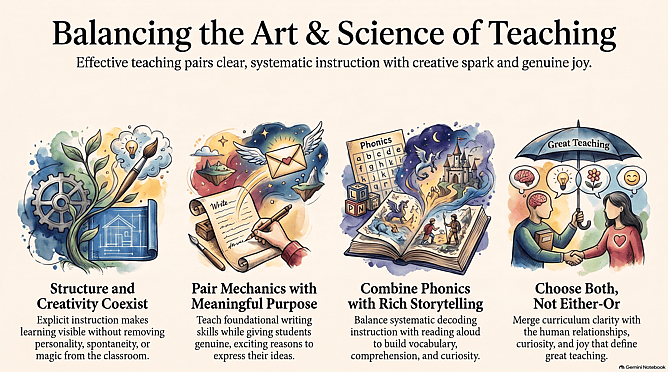
But explicit teaching is not about removing personality, creativity or spontaneity from the classroom.
It is about making the learning visible.
Let’s use our creativity to spark joy.
A poem provides a wonderful opportunity to explicitly teach vocabulary, while a great picture book can help us unpack sentence structure.
We can teach phonics and then delight in a funny story together. We can explore the features of persuasive writing before giving students something they genuinely care about to argue for.
And we can teach the features of writing without taking away children's reasons for wanting to write.
Writing is about having something to say
We need to be careful not to let the mechanics of writing overshadow its purpose. Why are we writing? And who are we writing to?
A child doesn't begin writing because they are excited to demonstrate their knowledge of a particular spelling pattern.
They write because they have something to say.
They want to tell us facts about sharks.
They want to explain what to do in an emergency.
They want to write a story about a fierce dragon.
They want to convince us that Doritos are the best chips.
They want to describe their happy place.
And sometimes, particularly for our youngest writers, they might produce chicken scratchings on the page.
That's okay.
Those marks matter.
They represent an emerging understanding that writing carries meaning.
Our job is not to wait until children have mastered every phonics pattern or can form every letter of the alphabet before we let them become writers. Our job is to help them become writers while we teach them how writing works.
We should be modelling writing, not simply setting a task and letting children ‘go for it’. We need to show them what good writers do. That means thinking aloud as we write, choosing words carefully for our audience and purpose, and showing children how we write a sentence, reread it, change it and make it better. Then they get to have a go themselves!
And what about reading?
The same is true of reading.
Decoding matters. It is an essential part of learning to read. No one can deny the importance of being able to make sense of English’s alphabetic code.
But decoding is not the whole story.
Reading is also about language, knowledge, vocabulary, comprehension, making connections, thinking, imagining and responding.
It's that desperate need to know what happens next.
It is discovering something you didn't know about the world.
It is laughing at a ridiculous character or crying because things are close to home.
It is being able to bake a chocolate cake or learn how to crochet.
The refreshed English curriculum places strong emphasis on systematic and explicit approaches to literacy, and the development of reading and writing knowledge and skills.
That is important.
But so is the teacher sitting down with a book and saying, "Listen to this..."
So is reading a wonderfully rich story aloud to a class who cannot yet read it independently.
So is shared reading - one of the most treasured parts of the day!
So is reading a novel aloud, a few chapters a day. Building the suspense and hearing the class chant, “Just one more chapter, Miss…”
Reading aloud to students and shared reading aren't the less rigorous cousins of decoding instruction. They're a non-negotiable part of literacy teaching. They build language, knowledge, vocabulary, comprehension and a relationship with books and ideas.
And those things matter.
We don't have to choose
Perhaps this is the most important message as we navigate the refreshed curriculum.
We don't have to choose between:
explicit teaching and creativity.
systematic instruction and wonderful books.
phonics and poetry.
knowledge and curiosity.
explicit writing instruction and giving children something worth writing about.
teaching the curriculum and creating classrooms where children are excited to learn.
For me, the challenge is to make sure we do both. We can do both.
Let's use the clarity of the refreshed curriculum to sharpen our teaching. We can plan carefully around our students' needs, explicitly teach the knowledge and skills they need, model and explain, check for understanding and give students plenty of opportunities to practise.
And let's keep making room for creativity, curiosity and joy.
This is what good teachers do
Because a curriculum can tell us what needs to be learned. It can give us guidance about when and how to teach it.
But the magic of the classroom still comes from the people in it: the teacher, the students and the relationships they build together.
Teaching is not simply the delivery of a curriculum.
Teaching is a creative act.
And as we move forward with the refreshed curriculum, let's make sure we don't lose that.
Erin McKechnie